Wednesday, 4 April 2012

Li Tianbing at the Stephen Friedman Gallery


China’s recent history has provided fertile ground for artists, particularly those addressing a western audience. Li Tianbing’s new series of paintings focus particularly on autobiographical family history. Having grown up in China during the 1970s, the artist won a scholarship to study in Paris where he now continues to work. Taking rare photographic images as a child captured by his father on a borrowed camera, Li inserts these fragments of a wider national story into large photo-realist paintings that use his young image as a means of connecting the past to contemporary life . The photographs are reproduced as a direct quotation in black and white, softly overlaying more generic scenes of life in China, which produces a cinematographic effect of montage and fades. Amongst, the finely finished photographic surface, paint is sometimes applied in textured blobs or allowed to run down the surface as a contradiction to the appearance of mechanical reproduction.
‘Don’t Touch My Dog’ depicts the young Li holding an imaginary dog surrounded by invented friends. Communist Party street flyers  are attached to a wire fence through which the children emerge. For Li, childhood is remembered as an experience of individual isolation and deprivation as a consequence of China’s introduction of a compulsory ‘one child’ policy. ‘Bullet Holes’ establishes a foregrounded, transparent screen damaged by fired guns through which we see two crouching infants looking back towards the viewer. An indeterminate air of menace shapes the narrative here. Many of these recent paintings also suggest repressed emotional trauma.
In some works, Li places his childish alter-ego amongst western artistic activity. In ‘Return With Fruitful Results’ the infant Li appears to returning from a shopping trip carrying a long blackboard decorated with chalk motifs by Michel Basquiat and holding a plastic bag archly branded with Warhol’s appropriated ‘Brillo’ logo. This child anticipates his adult engagement in a wider cultural conversation, aligning his formative, Chinese origins with a more universal adult aspiration. This picture illustrates Li’s use of hybrid sources arising out of lived observation, fantasy, education and travel. While such eclectic references present inevitable problems of interpretation and complex hybridity, these paintings are tempered by unique memory and experience.

Friday, 17 February 2012

Jeff Wall at White Cube


Printed and mounted in his characteristic light boxes on a scale suitable for advertising, Wall exhibits two groups of photographs made in the past four years: a sequence of images shot in Sicily depict pre-existing, found sites while the contrasting pieces orchestrate scenarios that have a cinematic and fictional quality. ‘Boy Falls From A Tree’ illustrates a boy tumbling in the air towards the ground. Caught in mid-air with limbs splayed like a jumping cat trying to remain upright, the boy’s physical gestures fulfill the definition of a snapshot,  the ‘stolen moment’. But certain clues suggest a wholly staged event. A red, upright wheelbarrow stands against a garden shed beside a blue, plastic swing suspended from the tree. Each object helps to set the stage of a suburban garden. This image asserts both the traditions of homemade photography and the wandering opportunism of photojournalism.

‘Boxing’ illustrates two adolescent boys sparring with each other in a home. Every detail of the imaginary parents’ taste is ironically signaled in rows of ornaments on shelving that seems wholly contrived, devoid of any sign that this is a truly, functioning space. The fight between the boys with their gloved hands raised to strike is so precisely enacted within a domestic setting that its uncanny quality signals premeditation whilst managing to meet our expectations of the scene. Wall successfully establishes a tension here between   acceptance and doubt. The event itself is intrinsically banal while also achieving the grandeur of epic painting.

In ‘Band & Crowd’, Wall photographs a desultory concert in a dance hall. Every detail of the musicians on stage, the sparse audience and the architecture is an approximation of real experience. But such hyperrealism on this scale deliberately provokes a disquieting unease. Can a life-like impression be fully trusted in the formal splendour of this highly finished, backlit print?

These works reiterate Wall’s ongoing themes of visual intention and reception dating back to the 1970s, but his more distanced observations of Sicilian landscapes where contemporary life encounters history, promise new directions with less staging and the potential for even greater instability.

Tuesday, 3 January 2012

Jennifer West – 'Heavy Metals: Iron and Zinc' At Vilma Gold, London


Taking old footage of the film, ‘Jaws’, and a promotional trailer, West superimposes scratchy erasures and layers of erratically applied colour. This process almost eviscerates the underlying celluloid surface but not entirely, as fragments of discernible images and sound occasionally re-emerge to remind the viewer of the film’s original intentions. By deploying diverse materials such as metal compounds, dyes and vitamin residues across the surface of this old footage, West achieves multiple formal effects that resist coherence. The resulting moving image is formless and awkward. A degraded soundtrack accompanies snatches of original narrative so that the two altered films lead the viewer into a destabilizing sensory experience.

The longer film is titled ‘Heavy Metal Sharks Calming Jaws Reversal Film’ which alludes both to the metal degradation of the super-8 film and also to a reported soothing effect of Heavy Metal music on sharks. This strategy of appropriation and manipulation takes us towards a virtual negation of the original source material. Projected from the floor onto the wall, the setting speaks of redundant home entertainment resurrected in West’s blend of anarchic nostalgia, quotation and alteration.

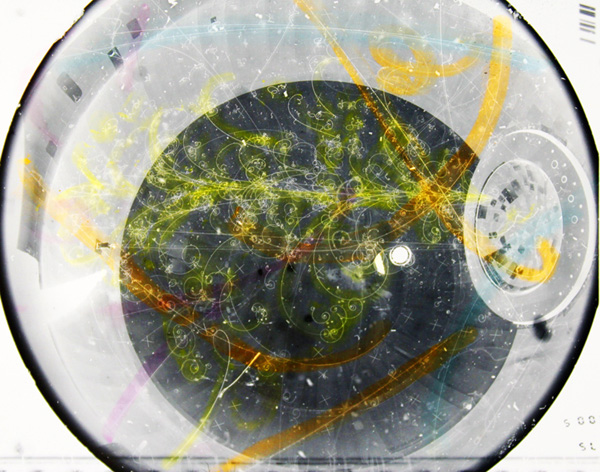
Two further projects adopt a more focused interest in analogue film and its exposure to specific effects. West shoots inside a special chamber at MIT to document the movement of Neutrinos in single image frames that are strung together in sequence. Delicate yellow, green and pink curling lines move across a dark void as the fixed camera traces the trajectory of these tiny particles, invisible to the human eye, which are being orchestrated within an artificial environment. Film here literally offers a new form of vision. In the same gallery ‘Mascara Rorschach Film’ is made by running mascara brushes down the film surface to create a series of flowing shapes reminiscent of the inkblot test in psychology. West again rolls numerous single frames together to animate areas of dark dye that become brightly purple where thinly applied. Firm, parallel brush lines sit beside less rhythmic, darker splashes. Resembling an unfurling Chinese scroll illuminated by inky brushwork or the subjective, urgent marks of Abstract Expressionism, this film is the exhibition’s most successful exploration of the formal and symbolic properties of this increasingly redundant medium.

Monday, 24 October 2011

Mike Kelley – Exploded Fortress of Solitude at Gagosian, Britannia Street


Fictional places have a strange allure. They will never be visited except in the imagination. Details must necessarily be invented and staged. Mike Kelley continues an ongoing project dedicated to Kandor, Superman’s birthplace, which he now keeps alive in artificial conditions like a organism on life-support. But Kandor presents a challenge to any re-enactment because the comic strip offers so many differing examples, embodying the multifarious and contingent nature of cities, subject as they are to infinite representation.

The centerpiece of this show is a grotto made of imitation black rock within which sits a resin model of Kandor emitting a rosy, seductive glow like a giant jelly. Sealed within the sustaining environment of a bell jar, fed a special gas, Superman keeps Kandor alive as a fragile utopia.  His fortress is reminiscent of sacred shrines where our loss of innocence can be contemplated with sorrow but also where redemption may be planned. Kelley takes the Superman conceit and addresses it with theatrical relish. Kandor assumes multiple forms, sometimes resembling melting polychromatic glass orbs or erect columns of crystals pointing skyward in the style of Art Deco futurism. Superman’s idealism is perceptible but his physical absence is telling. He idealizes the past and projects fantasy into the future, but must constantly slip away.

Inserted into the Superman theme are some conscious but disorientating digressions. A film with characters inspired by Hammer House of Horror plays out sado-masochistic rituals involving corn cobs and whips. Titled ‘Vice Anglais’ after the reputed sexual repressions of the English, Kelley takes his audience on a sinister tour through human cruelty but links the film to the wider exhibition by staging the melodrama on a set using the Superman themed works. Another sculpture titled ‘Tie A Yellow Ribbon’ creates a tableau of sentimental objects memorializing ‘S/andy’ to accompany images of both a Marine and young woman. Such an ambivalent gender echoes Superman’s own overlapping identities and suggests the performative nature of human relations.

Kelley’s interrogation of comic book values produces dazzling formal work but risks aestheticizing the source-material to the point of entertaining irrelevance. Unlike Roy Lichtenstein’s detached translations of graphic novels, Kelley’s appropriations are close to overreaching.

Friday, 9 September 2011

Masterplan No.9 at the Gibberd Garden, Harlow


Grace Adam’s ‘Masterplan No.9’ addresses questions that arise from Frederick Gibberd’s project to build Harlow New Town in the late 1940s in order to create a successful new community from the ground up.  Inspired by the title of a Gibberd architectural drawing, the exhibition uses his Harlow house and garden as an opportunity to explore the artist’s longstanding curiosity about notions of beauty and efficacy. William Morris once declared that you should have ‘nothing in your homes that you do not know to be useful and believe to be beautiful.’ But the values that inspire the creation of both objects and buildings alter and shift. Nothing in culture is fixed no matter how much we wish it were so.

Gibberd’s vision, in retrospect, may appear too assured, even naïve, but the idealism exemplified by Harlow remains as relevant as the years in which it was first conceived and constructed. Similar challenges for architects, designers and urban planners persist. How may we live today? How do we prepare for the future? Above all, how can we build sustainable communities that meet our social and material needs? The desire for urgent social change in the post-war period continues to act as an model.

The Gibberd Garden has become a fitting monument to the man whose role in twentieth -century design encapsulates all that was visionary after the catastrophe of war. Set amongst groves of trees and routes that lead the visitor through a series of outdoor rooms, the sculpture he collected reflects an eclectic, contemporary taste. The house, situated in countryside on the edge of the New Town,  is itself an imaginative response to necessity in microcosm. Denied permission to build a new structure, Gibberd adapted the existing one storey building as a satisfying home. This hybrid house reminds us how Harlow New Town was intended to be an adaptation to the surrounding ancient landscape of Essex with views from the Water Gardens and as surviving green wedges for recreational space.

The New Town was a very particular response to urgent social imperatives —for new housing and better living conditions with all the accompanying hope and aspiration of a victorious but exhausted nation. This modernist, almost romantic,  belief in progress is still beguiling particularly when we consider how urban environments  continue to frustrate the best intentions. The wars years produced tremendous difficulties for Londoners, bombed from the sky with new precision and cruel power. Imagine then the excitement of the resident whom Grace met on her walks around the town,  first cycling out from devastated London to look at the new homes being offered by this extraordinary social experiment. It’s hard today to locate an equivalent sense of promise.

Grace describes her site-specific work in the garden, ‘Small Folly’, as a ‘sculptural intervention’ in dialogue with the columns that Gibberd first rescued after making dramatic incisions into the Coutts bank façade on London’s Strand. As you head downhill from the house, you will discover them in a grove, close to the brook. They resemble props from a painting by Turner, cautionary metaphors for the cycles of history, fashion, hubris and decline. For all their nostalgia, these architectural fragments have an ironic quality. They have become 18th century imitations of classical antiquity forever stranded in time as amusing ornaments. This pastiche of Roman ruins is arguably an incongruous choice by Gibberd, a stone’s throw away from his progressive urban vision.

The adjacent row of four garlanded stone urns seems wholly superfluous even ridiculous, an example of ancient vessels translated into pleasing but dysfunctional copies. Gibberd was surely setting up a joke in this tableau, while at the same time proposing that architecture must respond to the needs of its age. The only role for these anachronistic  relics now is to create theatrical entertainment. However,  a paradox remains — for all his attachment to the concept of logical progress, Gibberd continues to value beauty for its own sake in the collection of sculpture and salvaged objects that he displayed throughout the garden in the manner of a Georgian aristocrat returning with souvenirs from the Grand Tour. In an interview he once said ‘the design of a town – like the design of a car – is based on function. It has to work smoothly and efficiently. But, as with a car, we like a town to give pleasure to the eye, to be beautiful.’

Grace engages with the irony of this Arcadian surprise by setting up a series of sculptural objects employing recycled wood, which echo features from the columns and urns. One component involves circular wooden slats kebabed together like soft scraps of compressed meat on a spit, their origins and histories lost in the process of stacking them together.  Where did these planks once lie? Whose feet have trodden across them? Each one embodies different stories and memories. But here they are reclaimed in a playful fashion to illustrate the contingency of all materials. Cut down, re-assembled and re-sited, the nutty-brown, varnished wood takes the domestic world into the garden — soft, organic grain in conversation with hard Portland stone, stained mossy green.

Another element in this group consists of an eight-sided wooden cylinder. Various chair legs and banisters grow out of it like MDF and mahogany horns on the head of a hunted stag. This mutant object formally mirrors the acanthus leaves in the Corinthian capitals carved on top of the stone columns. Such a clutter of shapes and textures suggests the slippery nature of taste and fashion. Modernism wished to dispense with imitation and quotation, but here in the tranquility of his garden, we discover Gibberd wryly tipping his hat to the past and Grace in turn implying our enduring confusion about what we seek from design.

Within the Gibberd Rooms, Grace has hung a series of watercolours and collages that convey Harlow’s original ambitions. Viewed from a cut embankment at the entrance to an underpass,  ‘Modern Fire Fighting’ illustrates a training tower for fire fighters, a tall symmetrical structure in glass and concrete so elongated that it begins to look wobbly.  As an amalgamation of sights and sensations, the image proposes how a healthy society anticipates all eventualities.  Grace articulates that gap between aspiration and implementation.  Below the tower, delicate lampposts stand ready to generate light for cars descending into a tunnel. An almost Caribbean, turquoise sky heralds a new age of provision.  In this imaginary climate, concrete glows instead of turning decrepit with damp.

Using collaged paper cutouts interlocking with architectural details made in watercolour, Grace captures the excitement of modernity and an air of accompanying disappointment.  Aspirations for a better world may be compromised by sobering realities. In the other works on paper, buildings rise up and cut across sightlines so that we continually experience the built environment as a series of competing geometries and surfaces. To be modern is to navigate a multiplicity of sensations, reminiscent of the astonished Cubists looking out of the windows of their Parisian cafes onto a new world. She asks the question what does modernity actually look like and how do we experience it? Is it a series of impressions, a checkerboard of concrete, glass and reflected light? Most importantly,  can our hopes for cities be realised?

As consumers and domestic dwellers, we remain attached to the pleasures of knick-knacks and furniture, the voluptuous curve of chair legs.  Our homes can never be arenas of perfection but are inevitably corrupted by dodgy taste and yesterday’s objects of desire becoming obsolete. Today’s hip sofa will in turn become a dubious heirloom or scrapyard fancy. In ‘Gibberds’ Chairs’ three armchairs function as if they were illustrations from a sale catalogue offering seductive possibilities for possession.  However, there is an uncanny familiarity because the original models belong to the same room. We are reminded that a functional object may assume many forms, styles and materials. Will a chair be round or square, upholstered or bare? Do we want old or new? How do we actually choose objects and what do they represent to us? Gibberd’s collection of Staffordshire dogs methodically arranged on the shelves in one corner nicely illustrates the idiosyncrasies of domestic interiors. This whimsical collection introduces  a sentimental  distubance into the cool,  efficient shell of his living space. Assembled over many years as a solution to the problem of what to give  Gibberd for his birthday, these china animals present a conundrum.  Is there a teasing,  knowing enjoyment  here of kitsch, a guilty pleasure,  or on the contrary a timeless appreciation of craftsmanship and tradition?

Much contemporary art carries a palpable sense of disengagement and many artists have ceded the social and political debate to other media. Working in tandem with the Gibberd Rooms and Garden, Grace Adam humorously and incisively employs this setting to address the work and ideas of a pivotal moment in British social history.  ‘Masterplan No.9’ suitably unsettles this modest memorial in an enquiry about the beliefs of a particular age while simultaneously saluting those instincts  of our better nature to improve society. In the light of recent national events,  this impulse is vitally important  even if we encounter disappointment  and doubt along the way.


The exhibition runs until September 28.

Saturday, 27 August 2011

Guiseppe Penone at Haunch of Venison


Placed within a framing alcove above a formal staircase, a small sapling appears to grow out of a block of wood. Penone’s ‘To Repeat the Forest’ miraculously resuscitates a young sapling from a piece of commercial timber in which it has been entombed. Time has been stripped back and the facts of early genesis exposed. In this singular work alone, Penone demonstrates his lyrical interest in the irrepressible transitions that underlie all living and material forms.

‘Maritime Alps’, first made during the 1960s, documents how Penone retreats from urban life to photograph his physical encounters within the forest. With precision, he marks out where his body has touched the tree, using wire and nails embedded within the living bark. Elsewhere, the photographs record the action of installing a cage placed over a young tree which will ascend,  in tandem,  towards the light. Nature here expresses a primal response to human intervention. In the most pronounced gesture, he attaches a cast of his hand to the point of original touch oand subsequently documents how the tree grows around the tightly clinging hand. This ambivalent reaction appears both nurturing and suffocating. More recently, he subjects this invasive presence to radiography to create an eerie suggestion of disease, and the tree’s ensuing strategy for recovery.

‘Space of Light’is a hollowed trunk in which Penone strips out early growth leaving a vacuum filled with ambient light and a residue of resin as if the juices of the tree had pooled together in mortal exhalation. Richard Long’s ‘Stone Print Spiral’ shares the same room, a familiar unfurling circle on the floor harvested from a Danish river, which appears more assertive,  leaving less room for dialogue between fact and invention than Penone’s investigations of similar natural forces.  Long’s work, simultaneously shown in adjoining galleries, is more insistently concerned with the application of superimposed mathematical  and linguistic systems.

Penone also exhibits a remarkable new series of large drawings that extrude over paper backed by canvas.  Titled ‘Skin of Graphite’ these subtle works suggest patterns found on the surface of membranes, plants or rocks. The faint, silvery sheen of shapes made in pencil gradually emerge from the dark paper beneath and lock together in harmonious irregularity. These ambitious drawings serve to amplify Penone’s symbiosis of human culture and Nature, a dialogue of interdependence, control, impotence and renewal.

Monday, 27 June 2011

Miroslav Tichy at The Wilkinson Gallery


A burlesque dancer elegantly raises her arms and thrusts her chest forward with an exaggerated smile facing an unseen audience. Wearing a corset decorated with spangles, the performer is captured from below the stage. The image is hesitantly composed and clumsily cropped. Weak exposure produces a narrow tonal range and the surface is mottled with damage. Such poor formal qualities appear to be the work of a struggling amateur. But if a wider context is ever needed, then the work of Miroslav Tichy asks for patient consideration.

Born in 1926, Tichy initially made modernist paintings during the early years of Czech communism and lived through its subsequent repressions. Resisting socialist realism and prone to mental illness, he spent much of his life in a provincial town where he instinctively documented life on the streets around him employing a home-made camera. The exhibition illustrates how Tichy furtively creates a world exclusively inhabited by anonymous women. These tentative images exhibit an erotic fascination, but any contact with his subjects is detached, for they are passive and involuntary models. The camera instead allows the consolation of surrogate intimacy.

Through disguising foliage in a park, several athletic beauties play volleyball in communal pleasure. A couple of friends in bikinis leisurely talk beside a swimming pool. In another image, a woman’s head is cropped out completely, our eye drawn down to a large heart printed on the dress below the buttocks. Tichy’s photographs enlist our voyeuristic complicity. Occasionally he is discovered looking. One woman waits on the side of a road quizzically tilting her head towards him, aware of his gaze, which amuses rather than disturbs her. Cumulatively, these works assert a masculine isolation amongst so many women recorded in secret. They also bear an uncanny resemblance to state surveillance material.

Untitled and un-numbered, these tiny prints, float delicately in their frames without mounts. Having survived rats or prosaic usage as beer mats, they are curious remnants of a marginalized life that found some direction and self-expression through resilient image making. There’s a pathos in Tichy’s ‘outsider’ status being mediated through the lens, and therein lies the value of these strange images, as the products of a dedicated existential enquiry.